
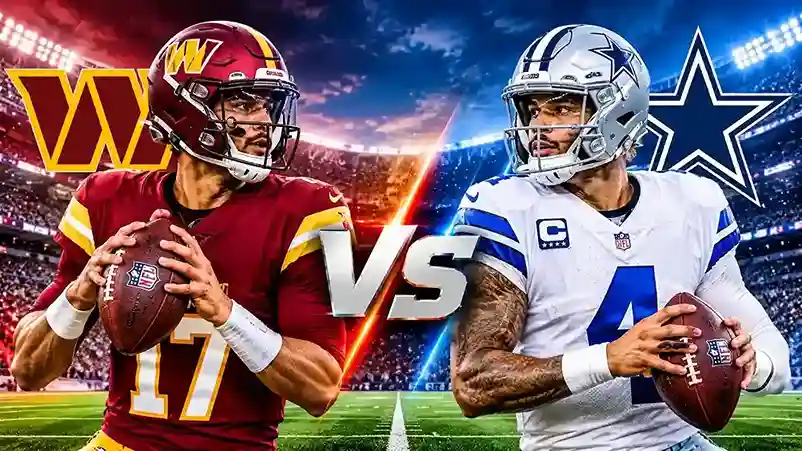
A final score tells you who won. It rarely tells you why. The real explanation of any Washington Commanders vs Dallas Cowboys game sits inside the player stats that never make the highlight package.
This breakdown goes beyond the box score headline. You will find quarterback efficiency, rushing production, receiver impact, defensive pressure and special teams swings, plus the latest numbers from the most recent meeting and a side-by-side comparison table.
If you want to understand this NFC East rivalry at a deeper level, start here.
Latest Updates: Washington Commanders vs Dallas Cowboys Match Player Stats from the 2026 Meeting
The newest chapter of this rivalry came in Week 2 of the 2026 season at AT&T Stadium. Dallas won 37-20, and the player stats from that game explain the result far better than the final score does.
Final Score and Scoring Flow
Dallas opened with a touchdown drive and a field goal for a 10-0 lead, then held a 17-10 edge at halftime. The Cowboys outscored Washington 10-3 in the third quarter and added another 10 points in the fourth. Washington never led and never tied the game.
Dak Prescott Rewrites the Franchise Record Book
Dak Prescott finished 26 of 31 for 279 yards, four touchdowns and zero interceptions, plus 26 rushing yards on four carries. His fourth touchdown pass of the day pushed him past Tony Romo for the most touchdown passes in Cowboys history, and CeeDee Lamb caught the record-setting throw. The win also kept Prescott unbeaten in home games against Washington.
Jayden Daniels Leaves with an Elbow Injury
Washington quarterback Jayden Daniels went down with a dislocated left elbow just before halftime. He had completed 11 of 17 passes for 96 yards and a touchdown, and he added 69 rushing yards on seven carries. Marcus Mariota replaced him and finished with roughly 111 passing yards and a touchdown to Stefon Diggs. Early reports described Daniels as week-to-week, so check the official injury report before the next meeting.
What Comes Next in the Series
Dallas has now beaten Washington three times in a row, following a 44-22 win in Week 7 of 2025 and a 30-23 win on Christmas Day 2025. The next matchup is a Week 18 trip to Washington, currently listed for January 10, 2027. The date and kickoff time can still move under the NFL’s flex scheduling rules.
For Washington, the most recent result was a 27-10 win over the Eagles on Sunday Night Football, which gave the team a lift heading into its next home game.
Why Commanders vs Cowboys Player Stats Look So Chaotic in This NFC East Rivalry
Few divisional rivalries carry as much history as this one. The two teams meet twice a year, and the games rarely follow the script set by the betting lines.
Divisional games raise the emotional temperature. Players tend to move faster, hit harder and gamble more than they would against an opponent from another conference. That intensity lands directly on the stat sheet in the form of explosive plays, sudden turnovers and late-game drama.
Coaching staffs also prepare differently for familiar opponents. They study tendencies for months and build special packages to attack known weaknesses. That level of preparation produces unusual statistical outliers, which is why the Washington Commanders vs Dallas Cowboys match player stats are worth reading closely rather than skimming.
Quarterback Showdown: Passing Yards, Touchdowns and Turnovers
Quarterback play decides most modern NFL games, and this matchup is a clear example. The two offenses want different things from the position, and the numbers show it.
Washington leans on rhythm, mobility and quick decisions. Dallas leans on play-action, vertical shots and a quarterback who has built a long track record of production against this opponent.
Commanders QB Performance Under Pressure
The Washington quarterback faces constant pressure when Dallas comes to town, and that pressure shapes the entire offense. In the latest meeting, the Commanders averaged about 2.65 seconds in the pocket, which is a quick clock for a team that wants to push the ball downfield.
Daniels was effective before his injury. His 11 of 17 line was efficient, and his legs added real value, since a good share of Washington’s rushing yards came from his scrambles. Once Mariota entered, the offense kept moving but leaned on shorter throws. Washington finished with 207 passing yards on 35 attempts, an average of just under six yards per attempt.
The costliest problem was finishing drives. Washington reached the Dallas red zone five times, yet it left points on the field, including a goal-line sequence at the end of the first half that produced no score. Those missed points mattered more than any single yardage total.
Cowboys QB Efficiency and Red Zone Numbers
Prescott posted a 143.8 passer rating in Week 2, with an 83.9 percent completion rate and no interceptions. Dallas threw it 31 times and scored four touchdowns through the air, all from short or intermediate range. Two went to Lamb and two to Jake Ferguson.
Ball security separated the offenses again. Dallas finished the game without a turnover, while Washington lost a fumble. In a rivalry game where each possession carries extra weight, protecting the football is one of the most reliable ways to win.
Ground Game Dominance: Rushing Stats That Tilted the Field
Passing gets the headlines, but the running game controls tempo and time of possession. The most recent meeting delivered a surprise here: the team that lost the game won the rushing battle by a wide margin.
Commanders Running Backs by the Numbers
Washington ran the ball 32 times for 182 yards, a strong average of 5.7 yards per carry. The Commanders gained 11 of their 24 first downs on the ground and held the ball for 31:29, nearly three minutes longer than Dallas.
Daniels supplied a large chunk of that production with seven carries for 69 yards. The backs added steady gains, including a first-down run from Rachaad White that set up Washington’s late first-half touchdown. The success of the ground game also shows up in yards after contact, where Washington gained 46 yards compared with Dallas’s 18.
The lesson is straightforward. Washington moved the ball effectively between the 20s and won the yardage battle, 389 total yards to 332. It simply did not convert that advantage into enough touchdowns.
Dallas Cowboys Rushing Attack Breakdown
Dallas took a different approach. The Cowboys rushed only 21 times for 66 yards, an average of 3.1 yards per carry. Javonte Williams carried 12 times for 30 yards and added three catches for 20 yards. Prescott’s four scrambles for 26 yards made up a large share of the rest.
That low rushing output did not hurt the Cowboys because the passing game carried the day. Dallas needed only 54 offensive plays to produce 37 points. Efficiency, not volume, was the story.
Wide Receiver and Tight End Match Player Stats You Cannot Ignore
Skill players create the plays that swing momentum in a single snap. In this game, the Dallas pass catchers turned short targets into points at a remarkable rate.
Big-Play Receivers on Both Sides
CeeDee Lamb was the best player on the field. He caught eight of nine targets for 153 yards and two touchdowns, and he now owns more touchdown receptions from Prescott than any other player. George Pickens added six catches on eight targets for 40 yards, which helped keep the chains moving and gave Dallas a reliable second option.
Washington’s pass catchers produced steady volume without the same explosiveness. Stefon Diggs scored twice, first on a four-yard throw from Daniels and then on a 20-yard fade from Mariota in the back corner of the end zone. Those were Washington’s only two touchdowns of the game. The Commanders also had two dropped passes, which hurt in a game where possessions were limited.
Yards after the catch were nearly even, with Washington at 89 and Dallas at 88. The difference came from air yards, where Dallas threw for 191 and Washington for just 118. Dallas simply attacked further downfield.
Tight End Targets and YAC Production
Jake Ferguson had a perfect day as a target: four targets, four catches, 43 yards and two touchdowns. Both scores came from close range, and both showed how effective the Cowboys’ tight end can be as a red zone and third-down option.
Washington’s tight ends play a more supportive role in this matchup, with value coming through blocking and the running game rather than receiving totals. That helps explain Washington’s strong rushing average, even though it limits the passing game’s ceiling.
Defensive Player Stats: Sacks, Pressure and Tackles That Changed Everything
Defense wins rivalry games more often than fans admit. The defensive side of the Washington Commanders vs Dallas Cowboys match player stats tells a more complicated story than the final score suggests.
Pass Rush Numbers That Shifted Momentum
Washington’s defense produced two sacks, seven quarterback hurries and six quarterback hits. On paper, that is a disruptive pass rush, and it forced Prescott to run for yards and take hits. Yet it did not stop Dallas from scoring because Prescott got the ball out quickly and found open receivers underneath.
Dallas recorded no sacks, but it still pressured Washington. The Cowboys hit the quarterback six times and forced two fumbles, one on defense and one on special teams, recovering one. Washington lost a fumble, and Dallas turned that mistake into momentum.
The key takeaway is that pressure numbers alone do not decide a game. Timing, coverage and decision-making all matter.
Secondary Coverage Stats and Ball Production
Dallas defended four passes while Washington defended two. The Commanders’ secondary allowed a high completion rate, with Dallas hitting 26 of 31 attempts. Short and intermediate throws were available all day, and Dallas took them.
Tackling was a small but important factor. Dallas missed five tackles and Washington missed four, so neither team had a major edge in that category. The difference came from where the plays happened. Dallas receivers turned catches into touchdowns near the goal line, while Washington’s defenders struggled to finish plays in tight space.
Special Teams Stats Most Fans Completely Overlook
Special teams rarely get the spotlight, but one kick can change the shape of a game. In the latest meeting, they helped Dallas extend its lead twice.
Brandon Aubrey went three for three on field goals, including a 60-yarder in the fourth quarter, and made all four extra points. Washington’s Dustin Stevens made two of three field goals, with makes from 27 and 47 yards and one miss. That difference of three to four points shaped how aggressive each team could be late in the game.
Kickoff returns also favored Dallas. The Cowboys averaged 30.5 yards on four returns, while Washington averaged 20 yards on six. Better starting field position helped Dallas stay ahead of the chains.
Punting was even. Dallas averaged 48 yards on its lone punt and Washington averaged 47, although Washington’s net average was higher thanks to a 14-yard return.
Head-to-Head Comparison: Washington Commanders vs Dallas Cowboys Match Player Stats Side by Side
Numbers are clearest when they sit next to each other. The tables below summarize the most recent meeting, a 37-20 Dallas win in Week 2 of 2026.
Team Stats Comparison
| Stat Category | Washington Commanders | Dallas Cowboys |
| Final Score | 20 | 37 |
| Total Yards | 389 | 332 |
| Passing Yards | 207 | 279 |
| Rushing Yards | 182 | 66 |
| Yards Per Rush | 5.7 | 3.1 |
| First Downs | 24 | 20 |
| Time of Possession | 31:29 | 28:31 |
| Turnovers | 1 | 0 |
| Sacks Recorded | 2 | 0 |
| Field Goals | 2 of 3 | 3 of 3 |
| Penalties | 5 for 38 yards | 5 for 32 yards |
Key Player Comparison
| Position | Washington Commanders | Dallas Cowboys |
| Quarterback | Daniels: 11/17, 96 yds, 1 TD (injured); Mariota: about 111 yds, 1 TD | Prescott: 26/31, 279 yds, 4 TD, 0 INT |
| Top Receiver | Stefon Diggs: 2 TD | CeeDee Lamb: 8 rec, 153 yds, 2 TD |
| Tight End | Supporting blocker and short target | Jake Ferguson: 4 rec, 43 yds, 2 TD |
| Lead Rushing Threat | Daniels: 7 carries, 69 yds | Javonte Williams: 12 carries, 30 yds |
| Kicker | Dustin Stevens: 2/3 FG | Brandon Aubrey: 3/3 FG (long of 60) |
What the Comparison Tells Us
Washington won the yardage battle, the rushing battle and the time-of-possession battle. Dallas won the scoreboard battle. The gap came from touchdown efficiency, ball security and the quality of the quarterback’s decisions inside the red zone.
For Washington, that is both frustrating and encouraging. The team moved the ball well enough to compete, and fixing finishing drives, drops and turnovers would shift this matchup considerably. For Dallas, the formula is simple: protect the ball, hit the explosive plays, and let the quarterback and receivers do the rest.
Key Turning Points That Defined the Final Score
Every rivalry game has two or three plays that change everything. In the most recent Commanders-Cowboys meeting, those moments were easy to spot.
The first came right before halftime. Washington, down 17-10, reached the goal line with almost no time left and chose to go for a touchdown rather than kick a field goal. The attempt did not produce points, and Daniels left the field injured on the same sequence. Losing both a scoring chance and the starting quarterback in a single moment tilted the game.
The second came at the start of the second half. Washington cut the gap to 17-13 with a field goal, but Dallas replied with a field goal of its own and then a touchdown pass to Ferguson, stretching the lead to two scores. From that point, Washington had to chase the game with a backup quarterback.
The third was Dallas’s 60-yard field goal in the fourth quarter. It turned a one-score game into a 17-point cushion and forced Washington into a hurry-up approach. Even when the Commanders scored again, the clock was already working against them.
Penalties and dropped passes added to the problem. Washington had two drops and five penalties, and each one cost the team a valuable chance to sustain momentum.
The Final Word on Commanders vs Cowboys Player Stats
Raw totals only tell half the story. The Washington Commanders vs Dallas Cowboys match player stats show a rivalry in which efficiency beats volume, and in which one turnover or one missed red zone chance can outweigh a hundred extra yards.
Dallas holds the edge in the series right now, with three straight wins and a quarterback who keeps producing against this opponent. Prescott’s franchise record, Lamb’s dominant day and Aubrey’s long field goal all reflect a team that knows how to finish.
Washington is not far behind in the areas that matter most. Its running game was strong, its defense created pressure, and its offense moved the ball. The health of Daniels and the team’s ability to finish drives will decide whether the next meeting looks different.
If you want to predict the next chapter, watch four things: the quarterback’s health, red zone efficiency, the turnover battle and special teams. That is where this rivalry is won and lost.
NFL Match Player Stats
NFL Match Stats · Commanders & Falcons Player Performance
NFL Match Stats · Lions & Bears Player Performance
NFL Match Stats · Broncos & Falcons Showdown Analysis
NFL Match Stats · Eagles & Commanders Player Performance
NFL Guide · Understanding Key Statistics & Metrics
NFL Guide · All 32 Teams & Divisional Breakdown