
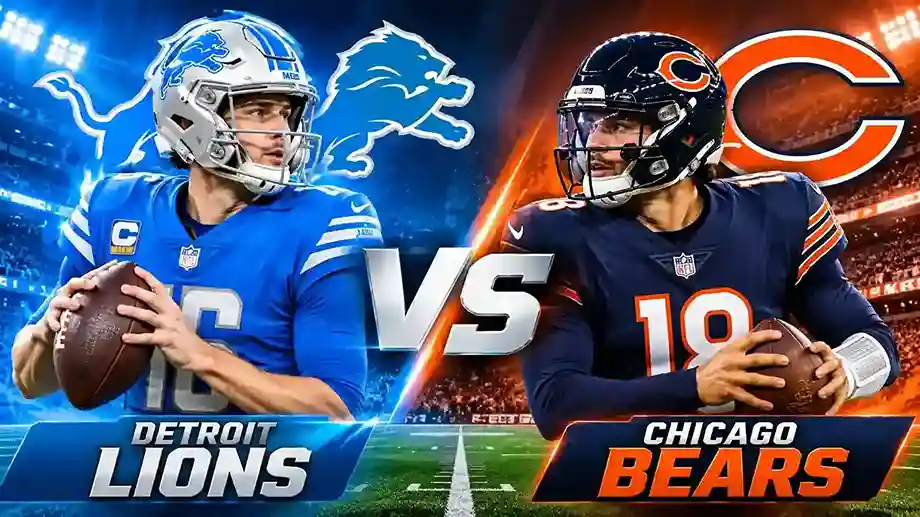
A final score only tells you who left the field happier. The real story sits inside the box score, where quarterback efficiency, rushing splits, and late-game turnovers explain how each result actually unfolded.
The Detroit Lions vs Chicago Bears match player stats from their two most recent meetings could not look more different. One game was a 52-21 blowout in Detroit. The other was a 19-16 nail-biter in Chicago that was decided on the final snap.
This breakdown walks through the passing, rushing, receiving, defensive, and special teams numbers that shaped both games. You will also find a head-to-head comparison and the newest updates on both teams heading into their next showdown.
Why This NFC North Rivalry Keeps Producing Statistical Outliers
These franchises have been facing each other since 1930, which makes this one of the oldest series in pro football. History alone adds emotional weight, and that tends to push players well above or below their usual production.
The two latest meetings prove the point. In the first, Detroit’s offense scored on nearly every possession and put up 52 points, the most Chicago had surrendered in a single game since 2014. In the second, the Bears erased a 16-point deficit in the fourth quarter before losing on a last-second field goal.
Game flow explains much of this volatility. Detroit built big early leads in both contests, which forced Chicago into pass-heavy comebacks that inflated the Bears’ fourth-quarter numbers. Meanwhile, Detroit’s possession advantage kept its offense on the field and gave its skill players more chances to pile up yards.
Context matters, then. A touchdown pass thrown while trailing by 16 points carries a different weight than one thrown in a tied game. Reading the stat lines with that in mind separates real performance from garbage-time padding.
Quarterback Performance: Goff vs Williams in the Latest Meetings
The quarterback matchup has been the headline of this rivalry for two seasons. Jared Goff is the veteran who has settled into a rhythm with Detroit’s offense, while Caleb Williams is the former first overall pick still building his résumé in Ben Johnson’s system.
Johnson spent years as Detroit’s offensive coordinator before taking over in Chicago, so each meeting carries an extra layer of familiarity between the sidelines. That familiarity has not translated into wins for the Bears yet. Detroit has beaten Chicago four straight times, including a Thanksgiving victory in 2024 and both games in 2025.
Passing Yards and Completion Rates
Goff was nearly flawless in the 52-21 win, completing 23 of 28 passes for 334 yards. He finished with a 156.0 passer rating, which is about as high as the formula allows without perfection.
His second outing was bulkier but less clean. Goff completed 27 of 42 attempts for 331 yards in the 19-16 finale, a lower completion rate of roughly 64 percent. Across both games, he threw for 665 yards on 50-of-70 passing.
Williams matched up with 19 completions on 30 attempts for 207 yards in the blowout, then went 20 of 33 for 212 yards in the rematch. His combined line of 39-of-63 for 419 yards shows a quarterback who stayed competitive in the air but never quite matched Detroit’s output.
Williams did leave that second game with a milestone. His 212 yards pushed his season total to 3,942, which broke the Bears’ single-season franchise passing record.
Touchdown-to-Interception Ratios
Goff’s touchdown total in the first meeting was a career-tying five, including three to Amon-Ra St. Brown, and he threw no interceptions. In the second game he threw one touchdown and one interception, with the pick coming on a deflected pass in the final minutes that Chicago’s Kevin Byard grabbed at the five-yard line.
Overall, Goff finished the two games with six touchdowns against one interception. That is an elite ratio, even though the closing game was a rougher outing by his own high standards.
Williams threw two touchdowns in each game, for four total, and gave the ball away once in each as well. His interception in the rematch came in the end zone during the third quarter, when Detroit’s Avonte Maddox stepped in front of a throw and erased a Chicago scoring chance.
The one-turnover-per-game pattern is the stat to watch. Bears quarterbacks cannot afford to hand away possessions against a team that converts them into points as efficiently as Detroit does.
The Ground Game: Rushing Stats That Shifted Momentum
Detroit’s rushing attack opened both games by forcing Chicago to account for it. Even when the ground game did not dominate the final box score, it created the space that made play-action throws so effective.
Chicago leaned on D’Andre Swift and a committee approach to stay in the fight. Swift scored on a three-yard run in the blowout and ran for 63 yards on 12 carries, a healthy 5.3 per attempt.
Jahmyr Gibbs and the Explosive Play Factor
Jahmyr Gibbs was the engine of Detroit’s backfield in both matchups. In the 52-21 win, he carried 12 times for 94 yards, a 7.8-yard average, and scored on a six-yard run on the opening drive.
The rematch was more of a grind. He gained 80 yards on 19 carries, a 4.2-yard average, but he also caught a touchdown pass, which showed how flexible Detroit’s offense is when defenses load the box.
Across both games, Gibbs rushed 31 times for 174 yards, an average of 5.6, and found the end zone twice. That kind of versatility makes him the most dangerous player on Detroit’s roster, because he can beat you as a runner, a receiver, or a decoy.
David Montgomery’s Short-Yardage Impact
David Montgomery played the bruiser to Gibbs’ lightning in the first meeting. He carried 11 times for 57 yards and scored from a yard out, which gave Detroit a 14-7 lead in the first quarter and set the tone for the rest of the afternoon.
Together, Gibbs and Montgomery combined for 151 rushing yards and two touchdowns in that game. It was a clean demonstration of why Detroit’s two-back system was among the most feared in football.
That partnership has since ended. Montgomery is now with the Houston Texans, which means Gibbs has taken over as Detroit’s primary ball carrier. The numbers in the latest-updates section below show how well he has handled the workload.
Wide Receiver and Tight End Production
Both offenses attacked through the air in contrasting styles. Detroit relied on timing, yards after the catch, and a trusted primary target. Chicago leaned on size, contested catches, and a deeper rotation of weapons.
Amon-Ra St. Brown’s Route-Running Dominance
Amon-Ra St. Brown was the most consistent receiver in the series. He caught nine passes for 115 yards and three touchdowns in the blowout, then followed up with 11 receptions for 139 yards in the finale.
That adds up to 20 catches for 254 yards and three scores across two games. More importantly, he made the biggest plays at the biggest moments. His 26-yard catch late in the second meeting moved Detroit into field-goal range just before Jake Bates won the game.
Jameson Williams also deserves credit as Detroit’s deep threat. He had only two receptions in the first meeting, but they went for 108 yards, including a 44-yard touchdown. That works out to 54 yards per catch, a number that makes defensive coordinators nervous.
Rome Odunze, Colston Loveland and the Bears’ Receiving Threats
Chicago’s receivers produced when the game allowed it. Rome Odunze led the way in the first matchup with seven catches for 128 yards and two touchdowns, averaging 18.3 yards per reception.
In the rematch, tight end Colston Loveland took over as the favorite target. He hauled in 10 passes for 91 yards and a one-yard touchdown that tied the game at 16. Cole Kmet then caught the two-point conversion that capped Chicago’s comeback, and Jahdae Walker added a 25-yard touchdown earlier in the fourth quarter.
On Detroit’s side, Sam LaPorta contributed in the short passing game and Brock Wright scored an eight-yard touchdown in the opener. Both tight ends are valuable blockers as well, which helps explain why Detroit’s ground game stays productive against loaded fronts.
Defensive Player Stats: Sacks, Interceptions and Game-Changing Plays
Defense rarely grabs the spotlight in rivalry recaps, but the individual defensive moments in these two games shaped both outcomes. One unit was overwhelmed early, and the other produced a key stop in the final minutes.
Pressure and Quarterback Hits
The finale was a pressure-heavy contest. Chicago defensive tackle Gervon Dexter Sr. sacked Goff in the second half, and Chicago’s defense held Detroit to field goals on several scoring chances.
Detroit finished 1-for-4 in the red zone, which is why the game stayed close. Still, the Lions managed 26 first downs to Chicago’s 16 and converted 6 of 13 third downs, compared with 4 of 11 for the Bears.
The blowout told the opposite story. Chicago actually converted more third downs (7 of 13) than Detroit (4 of 10), but it did not matter because Detroit turned its possessions into touchdowns while Chicago stalled and gave up chunk plays.
Secondary Coverage and Turnovers
Turnovers defined the late stages of the rematch. Maddox’s end-zone interception in the third quarter protected a 16-0 lead, and Byard’s interception later in the fourth quarter kept Chicago’s hopes alive. Byard’s pick was his league-leading seventh of that season.
Chicago’s Jaquan Brisker also deserves credit. He tipped the pass that Byard ultimately caught, a reminder that interceptions are often team efforts rather than individual highlights.
In the 52-21 loss, the Bears’ secondary gave up several explosive plays, including a 64-yard completion to Jameson Williams and a 44-yard touchdown to the same receiver. Those two plays alone accounted for most of the yardage damage in that game.
Special Teams Stats Most Fans Overlook
Special teams quietly settled the closer game. Jake Bates connected on four of five field goal attempts, including a 25-yarder in the third quarter and the 42-yard game-winner as time expired.
That final kick came after Detroit’s offense moved the ball out of a tie game with the help of St. Brown’s 26-yard reception. It capped a possession edge of nearly 36 minutes to 24 for the Lions, a gap that kept Bates’ leg in play all afternoon.
Chicago, on the other hand, attempted no field goals in the game, which says a lot about how its offense produced points: touchdowns or nothing. Detroit also lost returner Tom Kennedy to a rib injury on a third-quarter punt return, which forced its special teams unit to scramble for the rest of the game.
Detroit Lions vs Chicago Bears Match Player Stats: Head-to-Head Comparison
The tables below place the key players side by side using the verified numbers from the two most recent meetings.
Combined Totals From the Last Two Meetings
| Matchup | Detroit Lions | Chicago Bears | Edge |
| Quarterback | Goff: 50/70, 665 yds, 6 TD, 1 INT | Williams: 39/63, 419 yds, 4 TD, 2 INT | Lions |
| Lead Rusher | Gibbs: 31 att, 174 yds, 5.6 avg | Swift: 12 att, 63 yds (first game) | Lions |
| Top Receiver | St. Brown: 20 rec, 254 yds, 3 TD | Odunze: 7 rec, 128 yds, 2 TD (first game) | Lions |
| Tight End Impact | Wright: 8-yd TD; LaPorta: 3 rec, 26 yds | Loveland: 10 rec, 91 yds, 1 TD (second game) | Bears |
| Deep Threat | J. Williams: 2 rec, 108 yds, 1 TD | Walker: 25-yd TD (second game) | Lions |
| Interceptions Made | Maddox: 1 | Byard: 1 | Even |
| Kicking | Bates: 4-of-5 FG in finale | No FG attempts in finale | Lions |
| Scoreboard | 52-21 win, 19-16 win | Lost both | Lions |
Single-Game Snapshot: Blowout vs Finale
| Category | 52-21 Lions Win | 19-16 Lions Win |
| Goff Passing | 23/28, 334 yds, 5 TD, 0 INT | 27/42, 331 yds, 1 TD, 1 INT |
| Williams Passing | 19/30, 207 yds, 2 TD, 1 INT | 20/33, 212 yds, 2 TD, 1 INT |
| Gibbs Rushing | 12 att, 94 yds, 1 TD | 19 att, 80 yds (plus 1 receiving TD) |
| St. Brown Receiving | 9 rec, 115 yds, 3 TD | 11 rec, 139 yds |
| Bears’ Top Target | Odunze: 7 rec, 128 yds, 2 TD | Loveland: 10 rec, 91 yds, 1 TD |
| Third Down | Lions 4/10, Bears 7/13 | Lions 6/13, Bears 4/11 |
| First Downs | Lions 25, Bears 19 | Lions 26, Bears 16 |
The head-to-head view makes the gap easy to see. Detroit’s balanced approach, which mixed efficient quarterback play with a reliable ground game, outclassed Chicago in both contests. The Bears were at their best when their tight ends and Odunze got involved, but that production came too late or too inconsistently to change the result.
Latest Updates: Where Both Teams Stand Now
Plenty has changed since those two games, and the new season has already added fresh chapters to both rosters.
Detroit just ended Minnesota’s unbeaten start with a 19-15 home win. Gibbs carried 23 times for 153 yards and a touchdown in that game, while backup Sione Vaki added 11 carries for 65 yards. Those two backs combined for 218 of the Lions’ 230 rushing yards.
Gibbs is putting together a career year as the lead back. Through seven games he has 773 rushing yards and eight rushing touchdowns, and he is averaging more than 100 rushing yards per game. He is also the fifth player in NFL history under the age of 25 to reach 1,000 scrimmage yards and 10 touchdowns in his team’s first seven games.
Goff, meanwhile, has completed 67.7 percent of his passes for 1,964 yards this season. His latest outing, 18-of-25 for 176 yards with one touchdown and one interception, was modest by his standards. It did extend his streak of games with a touchdown pass to 29, and the interception was his first of the year. St. Brown leads the receiving corps with 571 yards, and edge rusher DJ Wonnum leads the defense with five sacks.
Chicago enters its Monday night road game against Seattle at 5-2 and riding a two-game winning streak. Williams was sharp in a 30-24 Thursday night win over New England, throwing for 308 yards and two touchdowns without an interception.
Luther Burden III had 130 receiving yards and a score in that game, and kicker Cairo Santos drilled a career-long 58-yard field goal with under two minutes left to seal the win. The Bears are also an NFL-best 5-2 against the spread, which tells you oddsmakers are still catching up to their improvement.
What comes next: The rivalry returns on Thanksgiving Day, when Chicago visits Ford Field. Detroit is chasing a fifth straight win over the Bears, while Chicago is still looking for its first win against the Lions under Ben Johnson. The teams then meet again in Week 17 at Soldier Field, which gives fans two more chances to update the numbers in this article.
What These Numbers Mean for the Rest of the Season
The Detroit Lions vs Chicago Bears match player stats from the last two games point to a clear conclusion. Detroit’s offense remains the more reliable unit, but Chicago has closed the gap enough that the next meeting is no longer a safe bet for either side.
For Detroit, the focus is on keeping Goff upright. The Vikings blitzed on nearly 90 percent of his dropbacks and sacked him three times in the latest win. Chicago will study that film closely, and it would be wise to expect extra pressure when the teams meet again.
For Chicago, the priority is ball security and red-zone finishing. Williams’ one-turnover-per-game pattern against Detroit is the clearest weakness in the head-to-head data, and fixing it is the fastest route to a win.
For fantasy managers, Gibbs is a clear must-start given his workload and production. St. Brown remains a steady PPR option, and Goff is a reliable quarterback against most defenses. On the Chicago side, Williams, Burden, and Loveland all carry upside, though their weekly output depends heavily on game script.
Final Thoughts on the Rivalry’s Statistical Story
The numbers from these meetings describe a rivalry in transition. Detroit still holds the edge in the head-to-head record, with four straight wins, and its stars have delivered in every important category. Chicago, though, has the tools to turn the tide: a record-setting quarterback, a deeper group of receivers, and a coaching staff that knows Detroit inside and out.
Keep an eye on the Thanksgiving Day clash and the Week 17 rematch. Based on how close the finale was, the next set of player stats could look very different from the last.